
Introduction
This state of affairs is particularly visible in smaller towns, which, according to analysts, leads to the entrenchment of a dualistic, semi-peripheral structure of the Polish economy. On the other hand, there is enormous will for change — 65% of small and medium-sized companies declare an intention to increase deployments of artificial intelligence, perceiving it as a vehicle of competitive advantage. So why do successful implementations occur so rarely?
The Baltic Digital Institute (BDI) Foundation, analysing this phenomenon from a practitioner's perspective, diagnosed the mechanism in which most entrepreneurs are trapped, calling it the Paralysis Cycle. It consists of three barriers that cannot be overcome alone. First, a chronic lack of time: owners and operational teams are so burdened with so-called manual steering and the day-to-day fire-fighting that they have no room to implement the automation that would, in the longer run, give that time back to them. Second, the capital barrier (CAPEX): the costs of security audits, ERP system licences or AI tools are prohibitive for the low-margin budgets of SMEs. Third, the competence gap: more than 40% of Polish SMEs point to a lack of appropriate digital skills as the main obstacle, and the absence of a dedicated IT director causes decision-making paralysis out of fear of making erroneous and costly investments. Breaking this impasse requires a thorough change in the philosophy of support.
The digital mentor concept (analogies)
The solution to the SME problem is not to sell yet another piece of software, but to build a new kind of relationship. The traditional market of IT consultancy is based on a transactional model that can be compared to the work of an emergency medicine doctor. An external consultant enters the organisation, diagnoses a single problem, performs a painful "operation" (e.g. the installation of a system), issues a high invoice and leaves the patient. In this model the organisation, often exhausted by the process, is left alone with the need to adapt and to maintain on its own the "health" of the new infrastructure.
The concept of the Digital Mentor reverses this paradigm. It is based on an analogy with a carer for the elderly, whose primary goal is not point-in-time crisis intervention but a constant presence, the building of deep trust and long-term assistance in everyday functioning. The Digital Mentor holds the entrepreneur's hand, monitors the company's digital condition and soothes the fear of new technologies. The approach is grounded in BDI's proprietary methodology of long-term support, combining diagnosis, mentoring and operational apprenticeship. Within it, BDI implements a hybrid approach described as "Human-in-the-Loop". It consists of relieving employees of laborious, mechanical activities by engaging autonomous AI agents, while the human factor takes on the role of strategic supervisor. This means providing a small company with information governance of corporate quality while keeping a human, supportive face.
Four phases of the programme
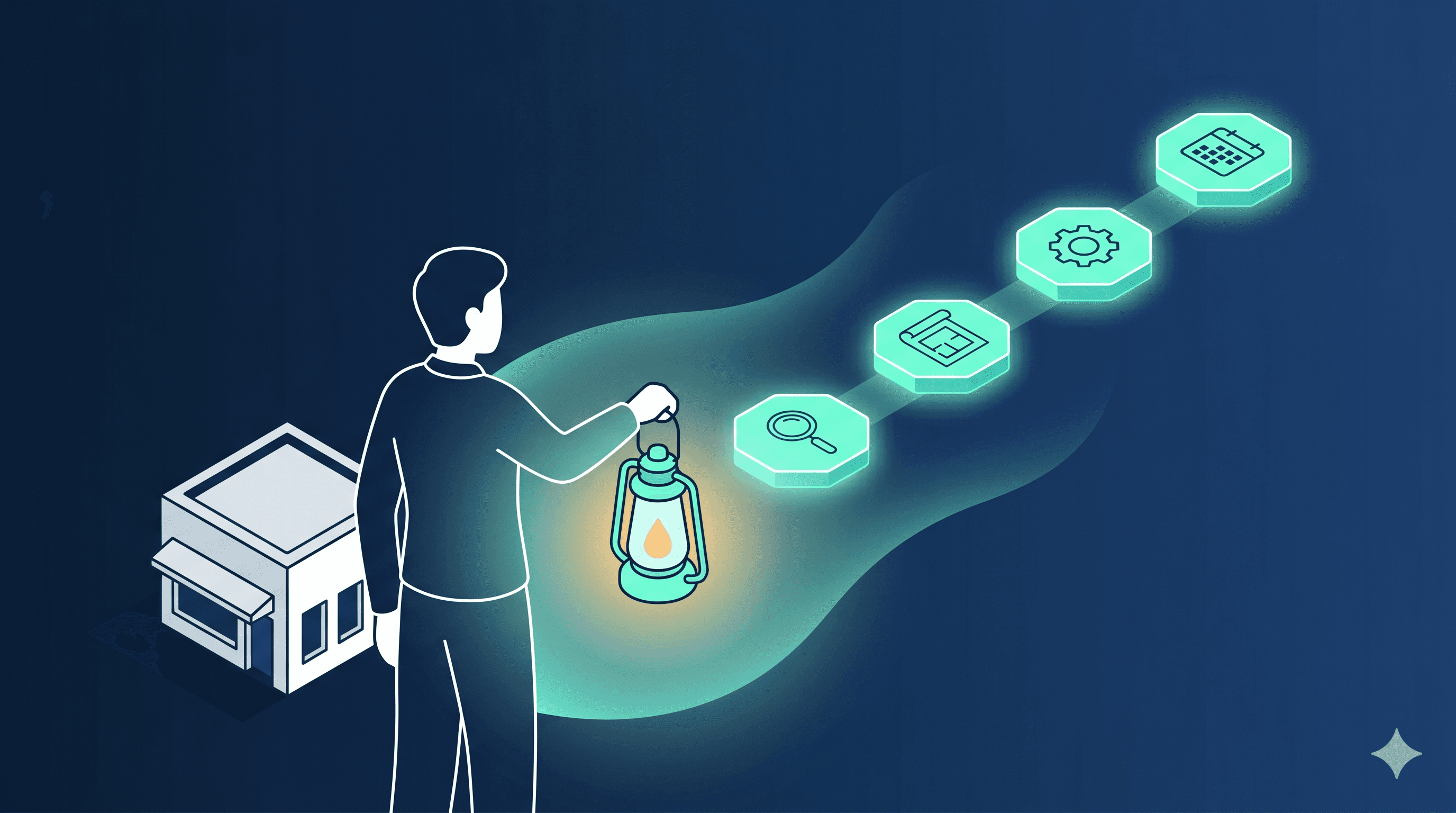
The functioning of the Digital Mentor for SMEs is not based on intuition but on a highly formalised, predictable cycle of cooperation, free from revolutionary shocks for the business. The programme has been broken down into four phases that mutually interpenetrate.
Phase 1 — Diagnosis: Every transformation begins with a thorough audit that does not engage the wallet but focuses on the facts. In this phase BDI's analyst, Olga, runs in-depth workshops and distributes anonymous questionnaires among the staff. The aim is to build an accurate map of business processes and to identify the real bottlenecks, such as excessive bureaucracy, data duplication or scattered CRM environments. We take care of establishing the facts, lifting the pressure off the owner.
Phase 2 — Plan: This is the key stage that differentiates a non-governmental organisation from commercial firms. At BDI we design the architecture of solutions in a tech-agnostic model. This means an absolute matching of technology to the actual needs and throughput of the company, and NOT the other way round. We do not push rigid software packages; we build a bespoke tool and IT plan.
Phase 3 — Implementation support: Instead of a "big bang" approach, we introduce changes in small steps through pilot tests in selected operational processes. Krzysztof Lizak, responsible at the foundation for deployments, manages the safe transfer of competences. In this phase the emphasis is on mentoring and calm, empathetic team training, which minimises resistance to innovation and the fear of losing jobs.
Phase 4 — Long-term care: The programme does not end with an acceptance protocol. The Digital Mentor moves into a phase of regular, quarterly reviews (check-ins) and ongoing recalibration of processes. We monitor whether the solutions actually reduce handling time or eliminate the costs of errors, offering full system maintenance in a clear and affordable subscription model.
Beneficiary profile
In order for the support to bring maximum return on the investment of time and capital, the Digital Mentor for SMEs programme is addressed to a carefully selected group of entities. The ideal programme beneficiary is an enterprise employing between 5 and 50 staff. This is the scale at which spreadsheets and reliance solely on the owner's memory cease to be safe, while the company is still too small to maintain a multi-person, costly IT department. The foundation notes particular effectiveness of its actions in the manufacturing and craft sectors and in modern B2B services.
Nevertheless, the most important criterion is not the industry but the psychological profile of the leader. The owner's readiness to change — the so-called "tone at the top" — is an absolute condition of successful digitalisation. The SME owner applying to the programme must be aware that the implementation of AI brings with it a transformation of the work culture and requires full transparency during the process diagnosis phase.
Participant benefits
By joining the foundation's programme, the entrepreneur becomes the beneficiary of a concrete business promise, bypassing the hidden costs of commercial agencies.
Time management. Before the programme: the leader and the team are overwhelmed by repetitive operational tasks (quoting, reporting, handling correspondence) — there is no time to think strategically. After the programme: repetitive processes are handed over to AI agents or automated, and the freed-up time flows back into the ownership role (planning, sales, product development).
Data security. Before the programme: documents scattered across private drives and corporate inboxes — high risk of digital incidents, no backups, weak access control. After the programme: canonical data-exchange structures (a single source directory, clear permissions) and corporate procedures for information protection adjusted to the scale of an SME are in place.
Scalability and expenditure. Before the programme: the high share of manual processes means that every additional client increases the cost of service proportionally — the firm is unable to grow without hiring new people. After the programme: cloud technologies and automation lower the threshold of scalability — additional orders are handled by the same team and licence costs are optimised to actual usage.
Programme participants have systematically reported an improvement in the comfort of their own work and that of their teams. Transparent mapping of workflows and the deployment of dedicated improvements have enabled many firms to make a smooth leap from anachronistic standards directly into the modern, automated economy abounding in quality and reliability.
Why an NGO (and not a commercial firm)
The decision to embed such an advanced deployment programme in the structures of a non-profit foundation was a conscious architectural choice. Krzysztof Rek, the founder of the Baltic Digital Institute, identified the underlying problem in relations between SMEs and technology providers: a lack of fundamental trust. Commercial deployment firms — so-called software houses or authorised partners — inevitably favour their own portfolio or the software of the producer with whom they have lucrative commission agreements.
The Baltic Digital Institute operates on the markets as an impartial entity. We do not engage in the resale of licences, nor are we capital-linked to any global systems supplier. The legal form of an NGO gives us a mandate of public trust — we sit on the same side of the table as the entrepreneur. Our statutory aim is to safeguard their business, not to impose so-called "vendor lock-in" — a technological and cost-based dependency on a single software provider. This unique position makes us similar to the European Digital Innovation Hubs (EDIH) and guarantees clients the highest reliability of recommendations.
Financing
In order to solve the key problem of the Financial Barrier, the Digital Mentor engages a mechanism known as Grant-to-Subscription. This is an advanced financial-engineering construct that lifts investment risk from the company entering the process.
First, the foundation acts as a navigator through the maze of EU bureaucracy, using widely available instruments of non-repayable public grants. The funds obtained in this way fully cover the costly initial capital outlay (CAPEX) needed to finance process diagnosis, the building of prototypes and the development back-end for AI software. They include large pools such as the flagship PARP (Polish Agency for Enterprise Development) programme — "Ścieżka SMART", which supports R&D and AI work (with a planned allocation of around PLN 1.3 billion for SMEs by 2026). In the region, support is provided by the European Funds for Pomerania and dedicated instruments from the National Recovery Plan (KPO), including low-interest loan programmes for the development of Industry 4.0.
Only once the platform has been stabilised does the client move to a highly optimised, transparent subscription model that finances solely the calm, ongoing technological support of the foundation.
Three anonymous case studies
The effectiveness of the approach in question is best verified by practice. We present three generalised, anonymised stories of Polish SMEs that went through the Digital Mentor path:
Case 1: A family artisanal bakery A dynamically growing manufacturing company with a long tradition had lost the ability to manually control the flow of goods to its numerous points of sale. Excessive returns and a lack of forecasting were leading to enormous waste of raw materials. After the diagnosis phase had been carried out, the Mentor supported the deployment of easy-to-use analytical algorithms tracking weather phenomena, the calendar of holidays and historical volumes. Participants reported improved margins and a tangible sense of calm in coordinating logistics, while the technology adjusted itself to the traditional character of the establishment.
Case 2: A local accounting office An expert office had become stuck in a trap of tons of stored paper and the need to repeatedly retype the same data between various state registers and analytical tools. This constituted a fundamental bottleneck, blocking the acquisition of new clients. BDI helped to deploy AI-based OCR technology for the intelligent categorisation of invoices, and then led the change in architecture so that information could flow freely in a centralised CRM environment. Participants reported an improvement in the ergonomics of their own work, shifting effort from tedious data entry to highly profitable tax advisory.
Case 3: A small manufacturing company and environmental standards An enterprise that was a subcontractor to Western brands was suddenly faced with the obligation to report carbon consumption and to implement Circular Economy (GOZ) solutions. BDI, navigating the public mechanisms financing circularity, selected independent IoT sensors and scoped the deployment of the necessary production procedures. Thanks to a discreet recalibration of processes, the entity preserved its value chain while, with no stress, fitting into the European regulatory framework.
Social impact
The transformation of SMEs is not limited to financial indicators (ROI). It is inseparably tied to raising the resilience of the entire region and to social and inter-generational integration, which resonates with the mission of the Baltic Digital Institute. Current statistics show that only 44% of Poles have basic digital competences, which lags behind the European Union average of 54%. Educating staff directly in the work environment solves this problem far more efficiently than academic courses.
The market success of the firms under our care impacts the employment chances of the most vulnerable social groups with which the foundation works — refugees from Ukraine, young people not in employment, education or training (NEETs) and people aged 50+. The person responsible for building these organic connections is Oksana, who creates space for meetings and integration around innovation. The digitalisation of SMEs also creates marvellous opportunities for the transfer of knowledge. The use within the foundation of talents such as Adam, a sharp intern representing the generation of "digital natives", helps to translate the vision of modernity into a language acceptable to experienced leaders, proving the measurable power of mutual understanding and education.
Summary
The high threshold of entry into AI-based technologies and the growing technological exclusion in the Polish small and medium-sized enterprise sector can be effectively reversed. This, however, requires a systematic abandonment of the transactional IT-purchasing model in favour of the responsible, lasting partnership embodied by the Digital Mentor. The guaranteed impartiality of an NGO foundation and the mechanism that lifts the investment burden through a safe grant-based lever (Grant-to-Subscription) make it possible to deploy our proprietary methodology of long-term assistance, freeing leaders and operational teams from the exhausting Paralysis Cycle. This is a promise of digitalisation that not only raises the security of the company but, above all, restores to entrepreneurs control over their time.
If you feel that your organisation is stuck under a glass ceiling of time scarcity and is struggling with insurmountable technological constraints — this is a sign to rethink the operational architecture. Stop fighting for survival from one week to the next. How to apply? We invite you to a simple, no-obligation conversation in order to sketch the first, free map of processes. Contact the Baltic Digital Institute, and we will examine how to successfully lead your company through the challenges of tomorrow.